


The Reality Behind Fox Control During Lambing Season
Author: David Tulloch
The Reality Behind Fox Control
At this time of year we are coming to the end of lambing. There is a lot of stuff on the internet about fox control and how it is unnecessary, and that they do not kill lambs – or worse, the ones that acknowledge that foxes do kill lambs but say "so what! the farmer has enough of them so it does not matter if he loses a few."
I am going to tell you the reality of this from first-hand experience, and why farmers deserve more respect than they get sometimes.

My grandfather was a shepherd, my father was a farm worker, and I come from a long line of keepers and farmers, so I guess it is in my blood. Farming, like keepering, is not a 9-to-5, 40-hour week job. A lot of people come into keepering and refuse to work more than 48 hours a week. The truth and reality is, it is a 7-day-a-week job, and for a small farm with one or two workers – usually the tenant or farm owner him/herself – that also means years without a holiday and rarely a day off, usually only for a funeral.
At certain times of the year the workload is heavier than others, especially when dealing with livestock. This time of year for most with sheep it is lambing: long, long days and even longer nights.

So let's get back to fox control and that discussion. Close your eyes and think for a second you are a sheep farmer. You have 300 ewes, all lambing or ready to lamb over a 4-to-5-week period – some, and I mean most, will do it in a shorter window. This is a whole month of work. The challenges these lambs face in their first few weeks are intense: weather and risk of exposure, illness, mother's illness, food scarcity, and constant predation. The list of predators outweighs what a farmer is legally allowed to control: badgers, raptors, pine martens, carrion and hooded crows, gulls, and foxes. Most of these are protected, and yes, the fox is the one that really can be controlled (and even then it can be hard work).
For each lamb lost, the farmer is losing roughly £100 per lamb. Now I know what people are going to say: "But if he has 300 lambs, one or two is not a lot to lose." But 300 lambs is only £30k, and for every lamb taken, that amount reduces. One problem fox can take 10 or even 20 lambs per year (if pleasure-killing), and if there is no fox protection at all, you could easily have more than one problem fox.

Think of the economics: if your only earnings are through your sheep, and you have 300 lambs earning only £30k a year, you still have to pay your bills and look after those sheep – and that payout comes only once a year. You cannot afford to lose a lamb. Many of those who complain about fox control cannot even live off £30k a year, let alone manage a farm, feed stock, and pay bills on that. And remember, the farmer is working 7 days a week, 365 days a year – even on Christmas. Not every fox is a problem, but when your margins are tight and your livelihood depends on your stock, you cannot afford to ignore the ones that are. Managing land is not cheap, and neither is running even a small farm.

Working in Real Conditions
It is easy to debate fox control online. It is much harder to deal with the reality of it on the ground. During lambing, and at other demanding times of year, the work rarely happens in perfect conditions or at convenient hours. It means early mornings, late nights, poor weather, tired eyes, and the constant need to make safe, accurate decisions under pressure.
That is why the conversation cannot stop at whether fox control matters. It also has to include how the work is actually carried out in the field. Identifying targets clearly, working safely in low light, and making confident, ethical shots all depend on equipment you can trust. For me, that means relying on optics that perform consistently, both in daylight and after dark.

The Optics I Trust in the Field
For deer management, livestock protection, and predator control, I need equipment that performs across a wide range of conditions. My main areas of concern are deer, foxes, and wild boar, although rabbits and feral pigeons also demand attention at certain times of year. Much of that work takes place at night, and reliable optics make all the difference.
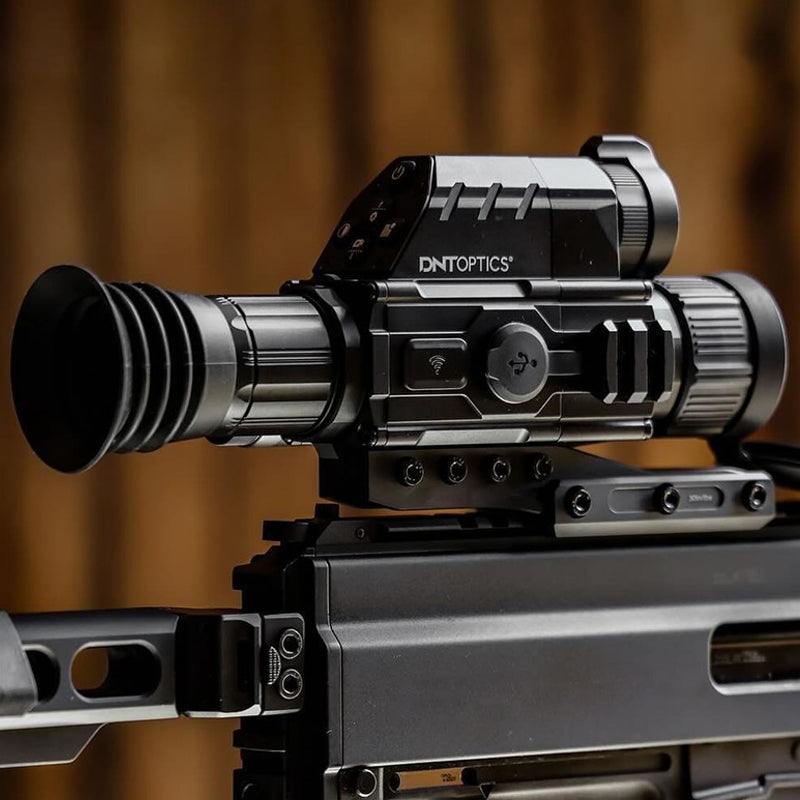
If I am doing mostly day work, then the DNT Optics' ZULUS 4K is a great digital night vision scope for stalking, allowing me to work straight through from day into night with fantastic battery life. The ZULUS HD V2 is also fantastic both day and night, with an amazing built-in IR that gives you night shooting out past 300 yards if the conditions are good.

What I love about these night vision scopes is the built-in laser rangefinder and bullet drop compensation, giving you confidence in your shot.
When a day scope is necessary, running the Arken Optics' SH-4J or the EP-5 makes light work of deer stalking with guests, or much-needed long-range shots on Sika.

Thermal spotters at the moment are a must in my field for effective deer management in forestry. I use the HOUND H635R thermal monocular with its built-in rangefinder, or the HYDRA HS635 thermal scope for quick target acquisition.
What surprises me the most – and what makes Arken and DNT stand out from the rest – is the affordability, giving professionals like me the ability to have top-quality products at an affordable price. With DNT and Arken, you can build a complete setup for the price many traditionally priced scopes alone would cost. You can't deny it makes sense.